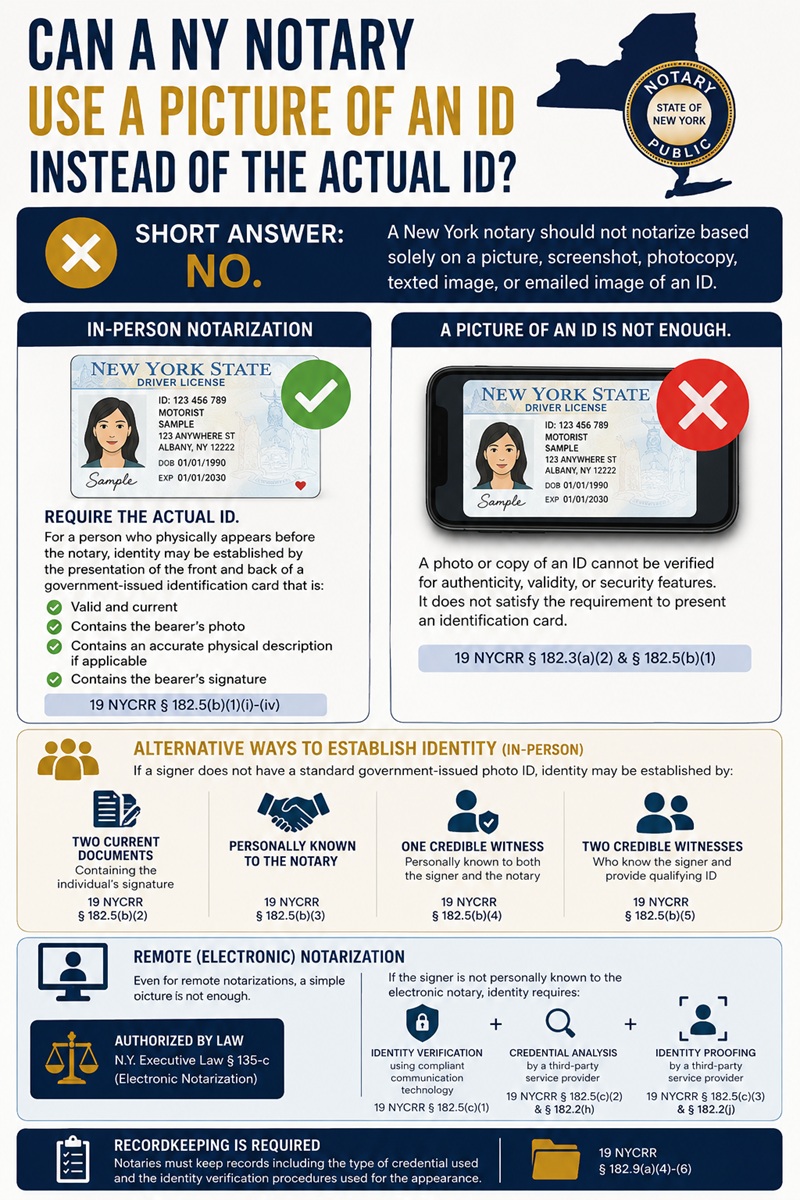
A New York notary public should not notarize a signature based solely on a picture, screenshot, photocopy, text message, or emailed image of a person’s identification. Under New York’s current notary rules, the notary must obtain “satisfactory evidence of identity” in one of the methods authorized by regulation. A casual picture of an ID is not the same thing as the presentation of an acceptable identification card, and it does not satisfy the rule by itself.
The governing rule is 19 NYCRR § 182.3(a)(2), which requires New York notaries to “obtain satisfactory evidence of the identity” of any principal or other individual appearing before the notary “in a manner authorized” by the Department of State’s notary regulations. The specific identity rule appears in 19 NYCRR § 182.5. For a person who physically appears before the notary, satisfactory evidence of identity may be established by the “presentation of the back and front of an identification card issued by a governmental agency,” but only if the card is valid and current, contains the bearer’s photograph, contains an accurate physical description if applicable, and includes the bearer’s signature. See 19 NYCRR § 182.5(b)(1)(i) to (iv).
That language is important. The rule refers to the presentation of an “identification card,” not merely an image of an identification card. A photograph of a license or passport can be altered, may omit security features, may not show whether the document is current or genuine, and does not allow the notary to inspect the credential in the ordinary manner expected during an in-person notarization. Therefore, for a traditional in-person notarization, a notary should require the actual government-issued ID card, or use another identity method expressly allowed by New York law.
New York does provide alternatives when the signer does not have a standard government-issued photo ID available. Under 19 NYCRR § 182.5(b)(2), identity may be established through at least two current documents issued by an institution, business entity, or federal or state government, so long as those documents contain the individual’s signature. Identity may also be established if the individual is personally known to the notary. See 19 NYCRR § 182.5(b)(3). In addition, the regulation permits identification by credible witnesses in certain circumstances. A notary may rely on the oath or affirmation of a witness who is personally known to both the signer and the notary, or on the oath or affirmation of two witnesses who know the signer personally and who provide qualifying government identification. See 19 NYCRR § 182.5(b)(4) and (5).
The answer is slightly different for electronic notarization, but even there, a simple picture of an ID is not enough. New York authorizes electronic notarization under New York Executive Law § 135-c. That statute allows an electronic notarial act through audio-video communication technology, but only if the statutory and regulatory safeguards are followed. The notary must be physically located in New York, the communication must allow real-time interaction by sight and sound, and the process must satisfy the approved identity-verification standards. See Executive Law § 135-c(1)(a), § 135-c(2), and § 135-c(4).
For a remote electronic notarization, 19 NYCRR § 182.5(c) requires more than simply showing or sending a picture of an ID. If the signer is not personally known to the electronic notary, satisfactory evidence of identity requires identity verification using compliant communication technology, credential analysis, and identity proofing by a third-party service provider. See 19 NYCRR § 182.5(c)(1) to (3). “Credential analysis” is defined as a process through which a third party affirms the validity of government-issued identification through review of public and proprietary data sources. See 19 NYCRR § 182.2(h). “Identity proofing” is a process by which a credential service provider collects, validates, and verifies information about a person. See 19 NYCRR § 182.2(j).
New York’s recordkeeping rules also support this conclusion. A notary must maintain records sufficient to document compliance with the notary laws and regulations. Those records must include the type of credential used to identify the principal and the verification procedures used for the personal appearance before the notary. See 19 NYCRR § 182.9(a)(4) and (5). For electronic notarizations, the notary must also record the communication technology and verification providers used. See 19 NYCRR § 182.9(a)(6). These requirements show that New York expects an actual, rule-compliant identity verification process, not an informal review of an image.
Accordingly, a New York notary should not notarize based only on a picture of an ID. For an in-person notarization, the signer should present the actual current government-issued identification card, or the notary should use another identity method permitted by 19 NYCRR § 182.5(b). For an electronic notarization, the notary must follow Executive Law § 135-c and 19 NYCRR Part 182, including credential analysis and identity proofing where required. A picture of an ID may be part of a compliant remote platform’s credential-analysis process, but standing alone, it is not a lawful substitute for satisfactory evidence of identity under New York’s notary rules.