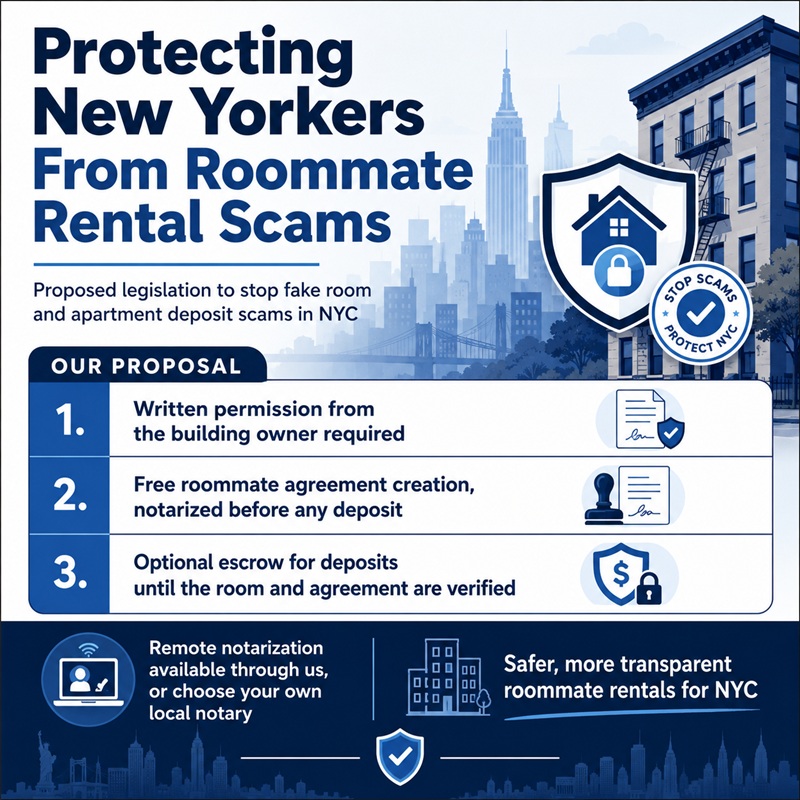
We are preparing to lobby for new legislation aimed at protecting New Yorkers from roommate and room-rental scams.
Too many people in NYC are being targeted by scammers who advertise fake rooms or apartments, demand deposits upfront, and disappear before the person ever sees the space. Some victims pay money for apartments that do not even exist, or for rooms the person advertising had no legal right to rent.
Our proposed legislation would create a clear procedure before anyone can collect a deposit for a room rental:
- Written permission from the building owner
Before a room can be advertised or rented, there must be written permission from the building owner allowing roommates or room rentals in that apartment. This helps confirm that the person offering the room actually has permission to do so and is not illegally or fraudulently collecting money.
- A written and notarized roommate agreement
Before any deposit is paid, the apartment owner, leaseholder, or authorized tenant and the potential roommate must enter into a written agreement. That agreement should identify the apartment, the room being rented, the deposit amount, monthly rent, move-in date, and the rights and responsibilities of both parties.
A notarized roommate agreement is important because it helps verify the identity of everyone involved. One of the biggest problems with rental scams is that scammers can use fake names, fake listings, fake phone numbers, and fake identities. When an agreement is notarized, the parties must present identification, confirm who they are, and sign the agreement in a way that creates a stronger legal record.
This protects both sides. The person looking for a room knows they are dealing with an identified party, not just an anonymous online listing. The person renting out the room also has a written record of who the roommate is, what was agreed to, and when the agreement was signed.
Our system will be able to create this roommate agreement for free. The parties can enter the basic details, review the agreement, and download it at no cost. After that, they can choose to have the agreement notarized remotely through us, or they can take it to any local notary of their choice. The goal is not to force people into one service, but to make sure there is a clear written and identity-verified record before money changes hands.
- An optional escrow system for deposits
We are also proposing an optional escrow system for roommate deposits. Instead of paying money directly to someone who may be a scammer, the potential roommate would place the deposit into a neutral escrow account. The funds would only be released after the room is verified, the written permission is confirmed, the agreement is signed and notarized, and the roommate is approved to move in.
If the room is fake, unauthorized, or the agreement is not completed, the deposit would be returned to the person seeking the room.
This is about basic consumer protection. People looking for housing should not have to gamble with their savings just to find a room. A simple verification, written agreement, notarization, identity confirmation, and escrow process can reduce fraud, protect renters, and make the roommate rental process safer and more transparent for everyone.
We believe New Yorkers deserve stronger protections before money changes hands.