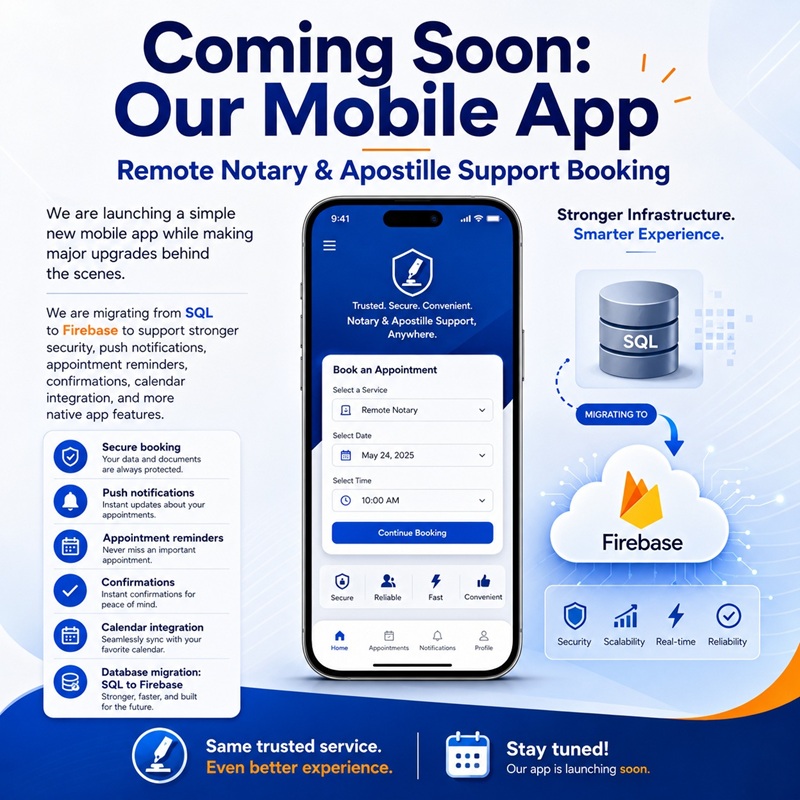
Notary Ninjas, LLC is preparing to release a new mobile app designed to make remote notary and apostille support booking faster, easier, and more organized for clients, businesses, and notaries. The first version of the app is intentionally simple, but it represents an important step toward a much larger platform. Our goal is not just to create an app where someone can schedule a remote notary session. Our goal is to create a secure, modern, and fully connected notary technology system that brings together remote notarization booking, apostille support, appointment management, client communication, document intake, and future mobile-first services in one place.
The mobile app will allow users to request remote notary services and apostille support directly from their phones. A client will be able to register, log in, schedule a remote notary appointment, upload documents for review, receive confirmation from our team, and track the status of their request. For apostille support, the app will help users begin the intake process, submit the type of document they need help with, and receive guidance on the next steps. Instead of forcing clients to call, email, or manually explain the same information multiple times, the app will create a cleaner workflow where the client’s request is organized from the beginning.
At this stage, the mobile app is simple by design. The larger work is happening behind the scenes. We are making significant changes to our database infrastructure so the app can grow into a secure, scalable, and more native mobile platform. One of the biggest upgrades we are working on is migrating from a traditional SQL database structure to Firebase. This migration is important because Firebase is built for modern app development. It allows mobile applications to communicate with the backend in real time, supports secure authentication, works well with Android and iOS, and gives us access to native features that are much harder to manage with a traditional website-only database structure.
Moving to Firebase will allow us to build features that clients now expect from a professional mobile app. For example, we will be able to send push notifications for appointment reminders, appointment confirmations, status updates, document review updates, and rescheduling notices. Instead of relying only on email or SMS, the app can notify users directly on their phones when something important happens. This is especially useful for remote notary sessions, where timing matters. A client should know when their appointment is confirmed, when documents are reviewed, when a notary is assigned, and when it is time to join the session.
Calendar integration is another major benefit. Once an appointment is confirmed, the app can help clients add the session to their phone calendar. Future versions can also support notary-side calendar syncing, availability management, and automatic reminders. This means fewer missed appointments, fewer scheduling errors, and a more professional experience for both the client and the notary. For businesses that use remote notary services regularly, this type of structure can create a much smoother booking process and reduce administrative back-and-forth.
The Firebase migration also helps us improve the way data is structured. In a traditional SQL system, data is usually stored in rows and tables, which works well for many websites. However, mobile apps often need faster access to user-specific data, real-time updates, and flexible workflows. Firebase allows us to organize data around users, appointments, documents, notifications, notaries, businesses, and service requests in a way that is more natural for mobile applications. This will help us create separate experiences for regular clients, business accounts, notaries, and administrators while still keeping everything connected.
A proper migration requires careful planning. The first step is auditing the existing SQL database. We need to review all current tables, relationships, user records, appointment records, document records, notary data, business accounts, payments, status fields, and admin functions. Before any data is moved, the current structure needs to be cleaned and mapped. That means identifying duplicate fields, outdated columns, inconsistent statuses, unused tables, and workflows that should be unified before the migration.
The next step is designing the Firebase structure. Instead of simply copying SQL tables into Firebase, the data needs to be reorganized for how the app will actually use it. Users should have secure profile records. Appointments should connect to clients, assigned notaries, uploaded documents, payment status, service type, appointment status, and notification history. Apostille support requests should have their own workflow, including intake status, document type, client notes, review status, and completion stage. Businesses should have account-level access, booking history, authorized users, and billing or membership information where applicable. Notaries should have availability, status, credentials, assigned appointments, and live booking visibility.
Security is one of the most important parts of this process. Firebase gives us tools such as Firebase Authentication, Firestore security rules, role-based access control, and secure cloud functions. These tools will allow us to control who can access specific records. A client should only see their own appointments and documents. A notary should only see appointments assigned to them or available opportunities based on the platform rules. A business account should only see its own users and bookings. Administrators should have higher-level access, but that access should still be logged, limited, and structured properly.
Once the new Firebase structure is designed, the next step is creating a migration tool. This tool will export existing SQL data, clean it, transform it into the new Firebase format, and import it into the correct Firebase collections. The migration should be tested in stages. First, a small sample of users and appointments should be migrated into a development Firebase project. Then the data should be checked for accuracy. User IDs, appointment IDs, status histories, uploaded document references, and account relationships need to remain intact. After testing, a larger migration can be performed in a staging environment before the final production move.
During the migration, we also need to make sure the website and mobile app can work together. The goal is not to abandon the website. The website, dashboard, admin panel, and mobile app should eventually communicate with the same backend. That way, a client can start a request on the website and continue from the app, or schedule from the app and receive updates in the dashboard. Notaries and administrators should also be able to manage appointments without data being split between separate systems.
This database upgrade will also make future development easier. Once the app is connected to Firebase, we can continue adding features such as real-time appointment status updates, in-app messaging, automatic reminders, business account dashboards, notary availability controls, payment confirmations, document review queues, and eventually deeper integration with our own remote online notarization workflow. Firebase also gives us a stronger foundation for scaling because mobile apps require a backend that can handle many users, fast reads and writes, and secure real-time updates.
The release of the mobile app is only the beginning. The simple version gets our users into a mobile environment, but the database migration is what prepares the platform for serious growth. Remote notary services, apostille support, loan signing coordination, attorney lead generation, business memberships, notary memberships, and future remote notarization tools all require a backend that is organized, secure, and flexible. By moving toward Firebase, we are building the infrastructure needed to support that future.
Notary Ninjas is not just creating another booking form. We are building a complete mobile-first notary service platform. The app will make it easier for clients to schedule services, easier for notaries to receive and manage appointments, and easier for businesses to coordinate remote notary and apostille support. As we continue improving the system, the mobile app will become a central part of how clients interact with our services, receive updates, manage appointments, and complete their notary-related needs from anywhere.